How to Read Crochet Patterns Without Feeling Confused
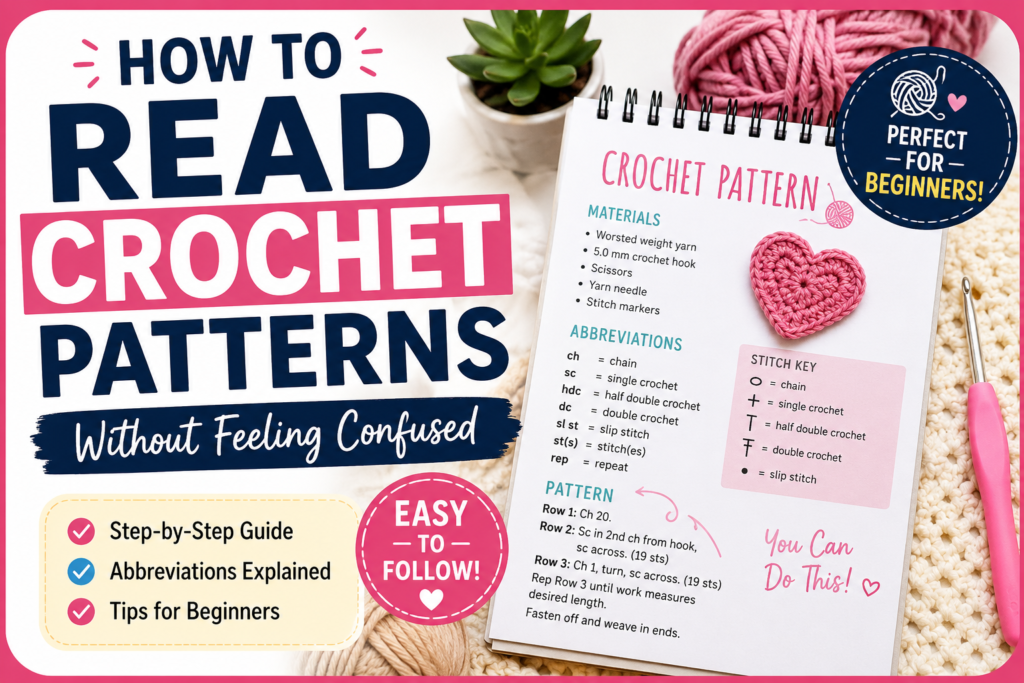
Everything changed the day I stopped guessing and finally understood what a crochet pattern was really trying to tell me.
Introduction
The first crochet pattern I ever downloaded looked like a secret code instead of a simple guide. There were strange abbreviations, random numbers, brackets, and symbols that made absolutely no sense. I stared at the page for ten minutes before putting my crochet hook down.
I honestly thought crochet wasn’t for me. Every video made it look effortless, yet every written pattern left me feeling more confused than before. I wondered if experienced crocheters were simply born knowing how to read these instructions.
A week later, I realized the problem wasn’t my skill. The problem was that nobody had explained how crochet patterns actually work. Once I understood the structure behind them, everything became surprisingly simple.
If you’ve ever opened a crochet pattern and felt overwhelmed, you’re in the right place. This guide will help you read any beginner-friendly crochet pattern with confidence, even if you’ve never finished a project before.
Why Crochet Patterns Feel So Confusing
Many beginners believe crochet patterns are difficult because they’re written for experts. In reality, most patterns follow a predictable structure that becomes easy once you understand the language.
Think of a crochet pattern like a recipe. A recipe doesn’t explain what flour or sugar is every single time. It assumes you already know the basic ingredients before following the steps.
Crochet patterns work the same way. Designers use abbreviations because writing “single crochet” hundreds of times would make every pattern unnecessarily long and difficult to read.
Once you learn the most common abbreviations and understand how rows are written, reading patterns becomes much faster than watching long tutorial videos.
Understanding the Anatomy of a Crochet Pattern
Every professionally written crochet pattern follows a similar format. Knowing what each section means removes most of the confusion before you even begin crocheting.
1. Pattern Information
At the beginning of every pattern, you’ll usually find basic information about the project.
This section tells you whether the pattern is beginner-friendly, intermediate, or advanced. It may also include the finished size, estimated completion time, and the type of project you’re making.
Reading this section first helps you decide whether the project matches your current skill level.
2. Materials Needed
Every crochet pattern lists the materials before the instructions begin.
You’ll usually see the recommended yarn weight, hook size, scissors, yarn needle, stitch markers, and sometimes optional accessories.
Many beginners skip this section and later wonder why their finished project looks completely different from the pictures.
Using similar materials gives you results much closer to what the designer intended.
3. Crochet Abbreviations
This is where most beginners panic.
Instead of writing “single crochet” hundreds of times, designers shorten words.
Here are the most common ones:
| Abbreviation | Meaning |
|---|---|
| ch | Chain |
| sc | Single Crochet |
| dc | Double Crochet |
| hdc | Half Double Crochet |
| sl st | Slip Stitch |
| st | Stitch |
| sp | Space |
| rep | Repeat |
| inc | Increase |
| dec | Decrease |
Learning these ten abbreviations will help you understand the majority of beginner crochet patterns.
What Parentheses and Brackets Mean
One of the biggest reasons beginners get lost is seeing instructions like this:
(sc, sc, inc) × 6
At first glance, it looks complicated.
But here’s what it actually means.
You complete:
- one single crochet
- another single crochet
- one increase
Then you repeat those three steps six times.
That’s all.
The parentheses simply group instructions together.
Whenever you see brackets or parentheses, think of them as saying:
“Repeat everything inside this group.”
Understanding Stitch Counts
At the end of almost every row, you’ll see a number in parentheses.
For example:
Row 4: sc in each stitch (24)
Many beginners think twenty-four means repeating the row twenty-four times.
It doesn’t.
The number simply tells you how many stitches you should have after finishing that row.
This is actually one of the best ways to catch mistakes early.
If your pattern says you should have 24 stitches but you only count 22, you’ll know something went wrong before moving to the next row.
Professional crocheters constantly count stitches because fixing one row is much easier than undoing ten rows later.
Learning to Read One Line at a Time
A common beginner mistake is trying to understand the entire page before starting.
Instead, focus on one instruction at a time.
Imagine you’re following GPS directions.
The GPS doesn’t tell you every turn for the next fifty miles all at once.
It simply says:
“Turn left.”
Then later,
“Go straight.”
Crochet patterns work exactly the same way.
Complete one instruction.
Pause.
Check your stitches.
Then move to the next line.
This simple habit dramatically reduces mistakes.
Example Pattern Walkthrough
Let’s look at a real beginner example.
Row 1: Ch 20
This means create twenty foundation chains.
Nothing more.
Row 2: Sc in second chain from hook, sc across (19)
Start in the second chain from your hook.
Make one single crochet in every chain.
When you finish, count your stitches.
You should have nineteen.
Row 3: Ch 1, turn, sc across (19)
Create one chain.
Turn your work around.
Single crochet into every stitch again.
Count.
You should still have nineteen stitches.
Notice how much simpler patterns become when you read each sentence slowly instead of trying to decode the whole page at once.
Why Beginners Should Never Skip Pattern Notes
Pattern notes are often ignored, but they contain some of the most helpful information.
A designer might explain that turning chains don’t count as stitches or that certain rows should be worked through the back loop only.
Missing one small note can completely change how your project looks.
Experienced crocheters always read the notes before picking up their hook because those details prevent frustration later.
Crochet Symbols Are Easier Than They Look
The first time I saw a crochet chart, I almost closed the PDF. Instead of words, it was filled with tiny circles, crosses, lines, and shapes that looked more like a treasure map than a craft guide.
A few weeks later, I discovered something surprising. Crochet charts are actually universal. Unlike written instructions that change between countries, symbols stay almost the same everywhere.
Once you recognize the most common symbols, you’ll often finish a project faster because your eyes can follow pictures more naturally than long paragraphs of text.
For visual learners, crochet charts become one of the easiest ways to understand a pattern after a little practice.
Common Crochet Symbols
Although different designers may use slightly different layouts, these symbols appear in most crochet patterns.
| Symbol | Meaning |
|---|---|
| ○ | Chain (ch) |
| ✕ or + | Single Crochet (sc) |
| T | Half Double Crochet (hdc) |
| T with one slash | Double Crochet (dc) |
| ● | Slip Stitch (sl st) |
| V | Increase |
| Λ | Decrease |
You don’t need to memorize every symbol on day one. Learn a few at a time, and soon they’ll feel just as familiar as written abbreviations.
US vs UK Crochet Terms
One mistake causes more confusion than almost anything else.
Many beginners don’t realize that crochet terminology changes depending on where the pattern was written.
The stitches themselves stay the same, but their names are different.
Comparison Table
| US Term | UK Term |
|---|---|
| Single Crochet (SC) | Double Crochet (DC) |
| Half Double Crochet (HDC) | Half Treble Crochet (HTR) |
| Double Crochet (DC) | Treble Crochet (TR) |
| Treble Crochet (TR) | Double Treble Crochet (DTR) |
Imagine buying a beautiful crochet pattern from another country and wondering why nothing matches the photos. In many cases, the only issue is the terminology.
Always check whether the designer uses US or UK crochet terms before you begin.
Why Repeating Instructions Saves Time
Patterns often include instructions like:
Repeat Rows 2–5 until desired length.
At first, beginners think they’re missing information because the pattern suddenly stops giving detailed instructions.
In reality, this is done to keep the pattern shorter and easier to read.
Instead of writing the same four rows twenty different times, the designer simply tells you to repeat them.
Professional crochet patterns use repetition constantly because it keeps instructions clean and organized.
Understanding Asterisks in Crochet Patterns
Sooner or later, you’ll see instructions like this:
*Sc 3, Inc* Repeat from * to end.
This scares many beginners, but it’s actually very simple.
The asterisks mark the section you need to repeat.
Think of them like quotation marks around a group of stitches.
Everything between the two stars gets repeated until the designer tells you to stop.
Once you understand this rule, many complicated-looking patterns suddenly become much easier to follow.
Why Counting Every Row Matters
Many beginners only count stitches when something looks wrong.
Experienced crocheters count every single row, even when everything seems perfect.
Counting takes less than thirty seconds but can save hours of frustration later.
Imagine discovering a missing stitch after finishing twenty rows. You’ll probably have to undo a large part of your project.
Checking each row as you go makes fixing mistakes quick and painless.
Should You Print Crochet Patterns?
Some people love printed copies.
Others prefer tablets or phones.
Neither option is wrong.
Printed patterns make it easy to highlight completed rows, write notes, and keep your place with a pencil.
Digital PDF patterns are convenient because they never get lost, can be downloaded instantly, and are easy to store in folders.
Choose whichever helps you stay organized.
Free Crochet Patterns vs Premium Crochet Patterns
One question every beginner asks is whether free patterns are good enough.
The answer depends on what you’re trying to achieve.
Here’s a comparison.
| Feature | Free Patterns | Premium PDF Patterns |
|---|---|---|
| Cost | Free | Paid |
| Instructions | Sometimes brief | Usually detailed |
| Photos | Limited | Step-by-step photos |
| Support | Rare | Often included |
| Error Checking | Varies | Usually tested |
| Printing Quality | Basic | Professional PDF |
| Beginner Friendly | Sometimes | Usually much easier |
If you’re just learning, free patterns are a wonderful starting point.
However, many beginners discover that premium patterns save time because they include better photos, clearer instructions, and fewer confusing sections.
That’s why many experienced crocheters eventually build a collection of high-quality PDF crochet patterns.
The Biggest Pattern Reading Mistakes Beginners Make
1. Skipping the Materials List
Changing the yarn weight or hook size can completely change the finished project.
Always check the recommended materials before starting.
2. Ignoring Gauge
Many beginners believe gauge only matters for clothing.
In reality, it affects blankets, bags, toys, and almost every crochet project.
3. Forgetting to Count Stitches
One missed stitch may seem harmless.
After ten rows, it can completely change the shape of your project.
4. Reading Too Far Ahead
Trying to understand the entire pattern before beginning often creates unnecessary stress.
Instead, complete one row at a time.
5. Using the Wrong Crochet Terms
Always check whether the designer uses US or UK terminology.
This simple habit prevents countless mistakes.
Expert Tips From Experienced Crocheters
After years of crocheting, many experienced crafters follow the same habits.
These small routines make every project smoother and more enjoyable.
- Read the entire pattern before making the first stitch.
- Highlight important notes with a marker.
- Use stitch markers often.
- Count stitches after every row.
- Keep a notebook for personal pattern notes.
- Save digital PDF patterns in organized folders.
- Practice unfamiliar stitches before beginning the project.
- Never rush through the first few rows.
- Compare your work with the pattern photos regularly.
- Take breaks when you feel frustrated.
These habits may seem simple, but they dramatically reduce mistakes and help you enjoy the creative process.
Pros and Cons of Written Crochet Patterns
Every learning method has advantages and disadvantages. Understanding both helps you decide whether written crochet patterns are the right choice for your next project.
| Pros | Cons |
|---|---|
| Easy to follow at your own pace | Can look confusing at first |
| Faster than watching long videos | Requires learning abbreviations |
| Easy to print or save as PDF | Some free patterns lack detail |
| Helps improve crochet skills quickly | UK and US terms can be confusing |
| Perfect for offline use | Requires careful stitch counting |
| Great for repeating projects | Beginners may need extra practice |
The good news is that most of the disadvantages disappear after completing just a few beginner projects. Once you understand the basics, written crochet patterns become one of the fastest and most enjoyable ways to create beautiful handmade items.
Frequently Asked Questions
Is it difficult to learn how to read crochet patterns?
Not at all. Most beginners feel confused because they try to understand everything at once. Once you learn common abbreviations, stitch counts, and pattern structure, reading crochet patterns becomes much easier.
Should beginners start with free or paid crochet patterns?
Free patterns are excellent for practicing basic stitches. However, premium PDF patterns usually include clearer instructions, better photos, and detailed explanations, making them easier for beginners to follow.
How long does it take to understand crochet patterns?
Many people become comfortable reading beginner crochet patterns after completing just three to five small projects. Regular practice builds confidence much faster than memorizing abbreviations.
Why does my finished project look different from the pattern photo?
The most common reasons include using a different yarn weight, incorrect hook size, skipping the gauge check, or accidentally adding or missing stitches.
What is the easiest crochet project for beginners?
Simple dishcloths, scarves, granny squares, and coasters are excellent first projects. They help you practice reading patterns without becoming overwhelmed.
Are PDF crochet patterns better than YouTube tutorials?
Both have their place. Videos are helpful for learning new stitches, while PDF patterns allow you to crochet at your own pace without constantly pausing and rewinding.
Find a Pattern You’ll Love Making.
Explore beginner-friendly digital crochet patterns for plushies, bags, home décor, and thoughtful handmade gifts.
Shop Digital Crochet Patterns →